 |
Family History
Wines Photography Books |
|
|
TheRagens Wine Tastings
|
In 1995, this paper was written to be the single reference on how Windows NT Workstation could be used in the engineering and scientific workstation market. After publishing this paper, I shifted responsibilities to focus on vertical marketing activities into the engineering market. This white paper was built around six major sections: By this time, some of the links referenced in this article may no longer be active. Although some have been updated to stay current, I haven't had time to update the others. Other related papers that I've written include:
Windows NT Workstation in Engineering and Science
A White Paper from the Business Systems Technology Series
| ||||||||||||||||||||||||||||||||||||||||||||||||||||||||||||||||||||||||||||||||||||||||||||||||||||||||||||||||||||||||||||||||||||||||||||||||||||||||||||||||||||||||||||||||||||||||||||||||||||||||||||||||||||||||||||||||||||||||||||||||||||||||||||||||||||||||||||||||||||||||||||||||||||||||||||||||||||||||||||||||||||||||||||||||||||||||||||||||||||||||||||||||||||||||||||||||||||||||||||||||||||||||||||||||||||||||||||||||||||||||||||||||||||||||||||||||||||||||||||||||||||||||
 |
It provides very strong integration between data and applications by executing your software on a single system. You can use a wide range of software—many leading engineering and technical applications are already available for Windows NT. Plus, there are thousands of Windows-based applications that run without modification. |
|
It gives you better price/performance capabilities with its ability to run on a broad variety of hardware. Multi-processor system support increases your options for even better performance. |
|
It plugs directly into your existing environment, enabling complete interoperability with existing workstations and servers. Integrated networking features supporting all common networks are built into Windows NT. |
|
Plus, Windows NT offers advanced features and reliability equivalent to most variations of UNIX, giving you the confidence to perform the most difficult tasks. A modern microkernel architecture ensures that it has the flexibility to add new capabilities as they become available. |
Today, Windows NT Workstation is being widely adopted in the technical community. By the end of 1995, Windows NT is predicted to outsell all other leading workstation operating systems. This paper will show you why Windows NT Workstation is the premier workstation operating system for technical users.
Your computers must be able to juggle multiple tasks efficiently. Engineers and scientists must be able to react quickly to the rapidly changing demands of today’s business and technical environments. On average, scientists and engineers spend no more than half of their time using their main technical application. The remainder is used to perform secondary tasks such as email, project management, document reviews, and other project-related tasks¾often on separate computers. Windows NT Workstation can increase productivity dramatically by consolidating these activities onto a single system and integrating applications and data more closely with the main project.
In today’s competitive environment, engineers must respond quickly to market demands. There are two factors that force engineers to participate more completely in the day-to-day business processes of their companies: concurrent engineering and the need to integrate engineering with other departments and into the business decision process. Similarly, scientists are increasingly dependent on similar business processes to coordinate joint research projects and interactions with various agencies.
Example: It’s not easy for UNIX users to share drawings or other data with personal computer users. Designs must be rendered to a file on a workstation and sent, via NFS or ftp, to a server. The PC user retrieves the file from the server and then converts it to a format his or her word processor understands. With Windows NT, it’s as simple as dragging a rendered image onto a document. And, with OLE, it’s even easier to maintain documents by linking the actual designs into the document so that design changes are automatically reflected.
Windows NT provides a single, high-performance operating system that helps integrate traditional engineering and scientific applications with basic productivity applications. With Windows NT, a single computer can run all these applications while providing a consistent user interface and complete access to networking, file and printer/plotter resources. Technical users benefit by working on a single system that is both powerful and cost-effective.
With Windows NT, you no longer need to switch between a dedicated workstation and a personal computer. This ability to integrate applications and share data more easily on a single system can result in reduced costs for hardware, training, and support. The key to this scenario is leveraging integration between applications and sharing data to improve the workflow and increase productivity. OLE and similar mechanisms within Windows NT are the cornerstones of these improved integration and productivity enhancements.
How many times have you wanted to simply transfer data or diagrams between different applications—yet been stymied because of incompatibilities between the applications or because the operating system doesn’t allow such transfers to occur naturally? This can be difficult to do in any computing environment, particularly in advanced technical fields where applications and data models are so complicated. The bottom line is that you want your applications to work together on a single system and to be consistent in order to easily share data between applications which may not use common data formats.
OLE is Microsoft’s answer to this problem. OLE object technology is used to integrate data across many different applications—enabling a high degree of application compatibility and open interoperability. For instance, OLE allows different applications to work together so that users can easily create compound documents that incorporate diverse types of information. The success of integrated application suites, such as Microsoft Office, serves as evidence of this end-user demand.
OLE is based on the Common Object Model (COM), which provides standard interfaces and inter-component communication. Because COM is a binary standard, OLE software components can be written in any language and can be supplied by any software vendor, yet still be seamlessly integrated within a single application. COM allows software component upgrades without affecting the operation of the overall solution. COM can also be used by corporate developers and system integrators to build custom components. These custom components can be easily integrated into any OLE-enabled application.
|
|
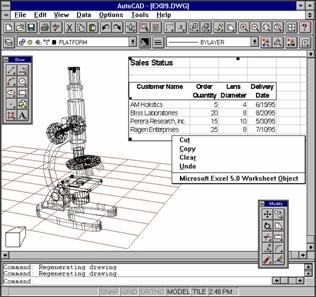
Together, Windows NT and OLE can improve business processes within, for example, a manufacturing company. Suppose the sales team uses a spreadsheet to maintain order data with quantity and widget dimensions specified by each customer. The spreadsheet can be sent, as an object in an email message, to the engineering department. In turn, an engineer can embed the spreadsheet into a design file (shown at left) and link the dimensions into the design. Finally, the modified design can be sent back to the sales department so that the complete product specifications can be included within an order confirmation letter.
This workflow process—using objects as a way to improve data integration between different applications and departments—enables the company to be more flexible and responsive to the needs of their customers. Improved internal communications reduces opportunities for error while increasing productivity.
OLE supports a wide range of functions. For technical users, the following OLE capabilities are likely to be of interest:
|
OLE Automation. Automation allows applications to expose command sets that operate within and across applications. For example, users can use their word processor to format comments on a specification diagram created within a mechanical design application. |
|
OLE Controls. OLE Controls are software components that extend and enhance an application. Popular development tools support OLE Controls as an efficient way to build applications using high-quality, prefabricated components. |
|
OLE Version Management. The component object model underlying OLE allows software components to evolve without disrupting existing applications. For example, an updated spelling checker can easily be accessible to all applications following an update to a word processing application. |
|
OLE Drag and Drop. Objects can be easily shared between applications and users. For example, experimental results can be dragged from a statistical tool into a word processor—or an engineer can drop a stress analysis of a new part into an email message and send it to other team members who can examine a complete copy of the analysis. |
|
OLE Documents. OLE Documents are a versatile form of compound documents that incorporate data from any OLE-enabled application. Users can convey ideas more effectively by incorporating any type of information into documents, including charts and tables, or ‘live’ data such as sound, video, and animation. |
OLE helps solve the problem of integrating data and applications. OLE gives you compatibility and consistency between applications created by a single vendor and, more importantly, between applications created by different software vendors. The result helps improve productivity by offering you the ability to share data more completely.
Today, it is difficult to share complex data between applications without physically converting data to a new format—often needing a multi-step conversion process or custom conversion tools. This extra effort can eliminate the productivity gains you expected from using advanced applications. OLE for Design and Modeling is a set of OLE extensions intended to make data sharing even easier.
|
|
Within the technical community, data models are more complex and can vary enormously between applications. The technology behind OLE for Design and Modeling supports the real world geometry engines required by CAD/CAM and GIS applications.
With this capability, you can integrate graphical objects, such as product schematics, from different sources and in a variety of data formats rather than simply transferring static pictorial data between applications. By ensuring that you can manipulate physical objects while retaining the spatial integrity and dimensions of those objects, your productivity can improve.
An application that understands only its own data format will fail to handle unfamiliar data models. Although some applications include conversion utilities, often users are forced to use static pictures or, even worse, to manually reenter data into a new application. OLE for Design and Modeling makes it possible to combine objects from several OLE-enabled applications to form a composite result. All OLE-enabled applications may contribute to the same model without requiring data translation.
Software developers, both commercial and in-house, can use OLE for Design and Modeling to build open software components that interact to produce OLE documents containing 2D and 3D objects. Those objects will maintain geometric relationships with one another in a real world setting. And, unlike proprietary systems, OLE for Design and Modeling provides an open framework where objects in different graphical formats from many different sources come together to form a unified model.
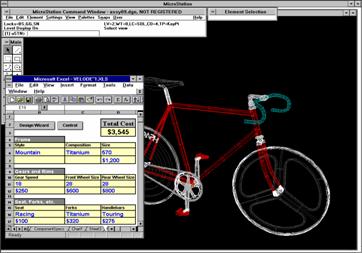
With OLE for Design and Modeling, Windows NT Workstation is the premier design environment. You can define and manipulate complex arrangements of 2D and 3D objects generated by CAD/CAM/CAE and GIS applications and share the objects with project scheduling, cost estimating, electronic mail, or other productivity applications.
Leading workstation applications are already available for Windows NT. Further, engineering and scientific vendors realize that Windows NT expands their potential markets. It enables them to offer powerful applications on systems hardware that is more widely available than proprietary workstations.
|
|
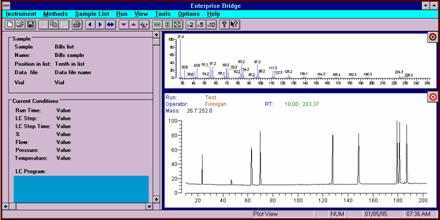
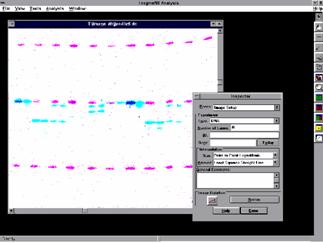
Windows NT is the first personal computer operating system that delivers the power needed for these applications. Leading engineering CAD/CAM vendors, such as Parametric Technology Corporation, Intergraph, Autodesk, Viewlogic and RASNA, have already delivered applications for Windows NT. Other vendors also offer high performance scientific and data analysis applications, such as the mass spectrometry system pictured at left.
Also, because Windows NT offers backwards compatibility with 16-bit applications, you can use a wide variety of productivity and office automation applications. The Win32® API, common across both Windows® 95 and Windows NT, helps ensure that the next generation of productivity applications will be available on both operating systems. Altogether, the widespread availability of technical and productivity applications available for Windows NT allows you to stop searching for an operating system and lets you be more effective in getting your work done.
The following vendor and product list is representative of hundreds of advanced engineering and scientific solutions that are already available for Windows NT.
|
Biomedical & Chemical |
Vendor |
Lead Product(s) |
|
|
Cambridge Scientific |
CSC ChemDraw™ |
|
|
Finnigan MAT |
GCQ, LCQ |
|
|
Molecular Dynamics |
ImageQuaNT |
|
|
Vox-L, Inc. |
Vox-L Visualizer |
|
CAD and Mechanical Design |
Vendor |
Lead Product(s) |
|
|
Ansys |
Ansys |
|
|
Autodesk |
AutoCAD R13 |
|
|
Bentley Systems |
MicroStation |
|
|
Computervision |
DesignView |
|
|
Intergraph |
MicroStation |
|
|
Parametric Technology |
Pro/ENGINEER |
|
|
RASNA |
Mechanica |
|
Electronic Design |
Vendor |
Lead Product(s) |
|
|
Intergraph |
VeriBest |
|
|
Massteck |
MaxEDS |
|
|
OrCAD |
OrCAD Capture |
|
|
Viewlogic |
Optium |
|
Graphics |
Vendor |
Lead Product(s) |
|
|
Elastic Reality |
Elastic Reality |
|
|
Intergraph |
Design Review |
|
|
NewTek |
Lightwave 3D |
|
|
NetPower |
OpenInventor |
|
|
Spatial Technology |
ACIS 3D |
|
|
Template Graphics |
OpenInventor |
|
Manufacturing |
Vendor |
Lead Product(s) |
|
|
Allen-Bradley |
ControlView |
|
|
CAMAX Technologies |
SmartCAM |
|
|
GE Fanuc |
CIMVision |
|
|
Intellution |
FIX/DMACS |
|
|
National Instruments |
LabVIEW |
|
|
Wonderware |
InTouch |
|
Statistics & Analysis |
Vendor |
Lead Product(s) |
|
|
Mathsoft |
MathCAD |
|
|
Microsoft |
IMSL Libraries |
|
|
SPSS, Inc. |
SPSS |
|
|
Visual Numerics |
PV-WAVE |
Table 1 - Representative workstation-class applications.
Workstation users need powerful systems because they have work that needs to get done. However, traditional solutions often lock users into proprietary hardware choices. UNIX workstations can be very expensive—often starting at $15k for a reasonably configured entry-level system for technical users and extending over $60k for top-of-the-line systems. Wouldn’t it be nice to choose from thousands of systems—covering both Intel® and RISC CPUs—that offer scalability and high performance options for demanding applications? Windows NT provides you with exactly this kind of open solution.
Windows NT offers a complete 32-bit environment that provides the performance of a workstation across multiple hardware platforms. Three factors provide these capabilities: portability across different system hardware; scalability for more CPU bandwidth; and a high-performance operating system.
Have you ever felt that you were stuck with a particular brand of systems hardware even though it might not give you the best performance? The choice of hardware available for Windows NT means that you can pick and choose the hardware that best meets the needs of your applications. Windows NT now supports four different CPU architectures: Intel’s 386/486/Pentium® and compatible microprocessors, Digital Equipment Corporation’s Alpha AXP™, MIPS® Technology’s R4X00, and IBM/Motorola’s PowerPC™.
The Windows NT architecture is designed with a microprocessor-independent layer, the Hardware Abstraction Layer (HAL), that ensures compatibility with today’s fastest microprocessors. The HAL also ensures that any new microprocessor can be supported quickly and consistently. Hardware independence allows users to choose between many systems to get the best performance¾for example, Windows NT is currently supported on over 4,000 computer systems. Windows NT is unique in that it is the only operating system that supports identical programming interfaces (the Win32 API), object technologies (OLE), and networking across four microprocessor families.
|
Operating System |
Workstation Hardware |
Cost (SRP) |
Test Time (minutes) |
Efficiency |
| Windows NT | FASTSeries MP |
$ 17,638 |
23.0 |
406 |
| Windows NT | FASTSeries SP |
$ 14,780 |
33.4 |
494 |
| HP-UX | HP 715/100 HCRX-8Z |
$ 33,325 |
22.4 |
746 |
| Irix | Indigo 2 XZ |
$ 36,800 |
21.2 |
780 |
| HP-UX | HP 735/125 CRX-48Z |
$ 60,715 |
14.6 |
886 |
| Irix | Indigo 2 Extreme |
$ 48,300 |
20.2 |
976 |
| Solaris | Sparcstation 20/61 ZX |
$ 34,495 |
32.4 |
1118 |
| Solaris | Sparcstation 5 Turbo GX |
$ 18,595 |
63.8 |
1186 |
| Solaris | Sparcstation 20/51 ZX |
$ 30,995 |
39.9 |
1237 |
Table 2 - Windows NT systems, compared to popular workstations, are cost-effective. Efficiency measures price/performance - lower is better.
With the choices this portability ensures, Windows NT Workstation offers power equivalent to traditional workstation systems. A typical benchmark uses Parametric Technology Corporation’s Pro/ENGINEER software, a powerful design and modeling tool, to model performance. This test uses a combination of computational and graphics functions to model a typical engineer’s system usage. It is representative of the demands that advanced users place on workstations.
The results show that the Windows NT systems (in this case, MIPS-based systems from NeTpower) can complete the tests in a time period much quicker than entry-level UNIX systems and are roughly equivalent to the mid-range UNIX systems. The final column, labeled ‘Efficiency’, shows that Windows NT systems are up to twice as cost-effective by comparing the results on a price/performance basis.
Portability helps protect your infrastructure investment by ensuring that you have a choice of hardware that you can use today and tomorrow. Because Windows NT is designed to be portable, any vendor can offer Windows NT on their systems—and this lets you make the right selection of computing equipment for your applications.
With advanced technical applications, you can run out of CPU horsepower fairly easily. Rather than investing in a new, much more costly system, wouldn’t you rather pop the cover off the chassis and simply add a second CPU? In addition to the hardware independence offered by Windows NT’s portable architecture and the performance benefits you can get from an initial selection of a high-performance CPU, Windows NT was designed to support multiple processors within a single system. This lets you squeeze even more performance from your system.
|
|
Symmetric multiprocessing (SMP) technology is used to get higher levels of performance. The Windows NT kernel enables multiprocessor support by allocating threads (small, independent executable components of applications) based on the thread’s priority across all available CPUs in a system. Any thread of any application can run independently on any available processor.
Even though the best performance increase will come from multi-threaded applications, you will often get a small performance boost running even a single threaded application on a multi-processor system. The Windows NT kernel dispatches all operating system threads across all available processors, including I/O, networking, and graphics.
The combination of portability, symmetric multiprocessing support, and the multithreading capabilities offered by Windows NT, results in a choice of systems hardware for Windows NT that meets the needs of even the most demanding users in the engineering and scientific community.
Many workstation applications use high-performance, high-resolution graphics to get the most realistic visual representation of data and designs. Until 1994, these high-end graphics capabilities were only found on expensive workstations. However, with the release of Windows NT 3.5, you now have an integrated option to get the same powerful graphics capabilities on personal computers.
Windows NT is the first commercial personal computer operating system to offer high performance 3‑D graphics features in a mainstream operating system by integrating the OpenGL 3‑D interfaces. High-performance graphics capabilities, such as those provided by OpenGL, form an extremely important foundation for many engineering, data visualization, and virtual reality applications. (See the OpenGL technology brief for details.)
|
|
Silicon Graphics originally introduced the IRIS GL (Graphics Language) graphics engine for use on their proprietary workstation systems. This technology enabled the development of powerful 3‑dimensional graphics applications. OpenGL was eventually developed as an open version of IRIS GL that could run on computer systems from other vendors. Today, OpenGL is the standard 3‑D interface supported by workstation hardware and software vendors.
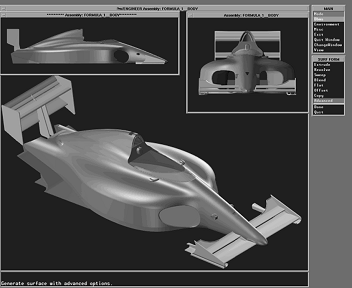
Many workstation applications support advanced 3‑D graphics using OpenGL technology today—including leading vendors in mechanical design and modeling, architectural drafting, animation, and virtual reality. Already, Windows NT applications from Parametric Technology, Intergraph and others use this advanced 3‑D rendering engine in their Windows NT applications.
In order to offer the greatest flexibility to users, Windows NT supports OpenGL using any one of three different modes. Any video adapter can be used with Windows NT using the software rendering mode. A variety of accelerated video drivers is available for the higher performance modes - and many more are in development.
|
3D accelerated hardware (3D-DDI drivers) |
|
|
Matrox |
MGA Impression Plus |
|
Oki Advanced Products |
TrianGL |
|
OpenGL accelerated hardware |
|
|
3DLabs |
GLint chipset |
|
Accel Graphics |
AG300 |
|
Digital Equipment |
ZLXp-E Series |
|
Evans & Sutherland |
Freedom Graphics |
|
Intergraph |
GLZ and GLI adapters |
|
Omnicomp |
3Demon adapters |
|
SPEA |
FireGL adapters |
Table 3 - Graphics vendors already have created OpenGL products for Windows NT.
The three hardware-supported modes for OpenGL graphics are:
|
Software rendering. This method lets a video adapter with no 3‑D capabilities use the basic Windows NT OpenGL engine. This is the slowest method of 3‑D execution—it depends on the floating point performance of the system. However, this “softGL” implementation guarantees that OpenGL applications will run on any Windows NT-based system regardless of graphics capabilities. |
|
3‑D accelerated. Microsoft has worked with the graphics hardware industry to help define a standard 3‑D Device Driver Interface. The 3‑D DDI is a set of extensions to Microsoft’s existing video device driver model. It supports 3‑D functionality such as z‑buffering and “spans,” if present in the hardware. This allows graphics vendors to use optimized features available in their hardware to accelerate OpenGL for Windows NT. |
|
OpenGL accelerated. This is the highest level of acceleration available for OpenGL and is similar to that used by Silicon Graphics’ high-end workstations. This “client driver” model allows the adapter vendor to develop a driver that effectively replaces the software engine in Windows NT with hardware. In essence, it implements OpenGL in silicon allowing Windows NT simply to pass the OpenGL call directly to the hardware. |
With these high-performance options for OpenGL 3‑D graphics within Windows NT, you get the graphics engine that was used to design the special effects in Jurassic Park and other Hollywood films.
In many environments such as manufacturing controls and scientific data acquisition, embedded applications that manage time-critical responses have some of the most demanding performance and responsiveness requirements. Many of these real-time applications have used specialized operating systems to help provide the solution. Windows NT provides a different, simpler option. (See the Windows NT real-time paper for more details.)
Windows NT is designed from the ground up to be a highly responsive, general-purpose operating system. However, many of the design choices made within the Windows NT architecture also result in a high level of control and responsiveness that is required to manage these time-critical, real-time applications. These design choices enable Windows NT to be used as the operating system for many real-time applications, using standard capabilities included with the operating system.
Real-time applications not only need to respond to external events properly, but they also need to respond within certain, specified time parameters. In particular, Windows NT supports real-time applications capabilities in the following critical areas:
|
Assigning real-time priorities to applications and scheduling their execution. Windows NT offers 32 different priority levels, of which 16 are defined as real-time priorities. |
|
Ensuring thread and process synchronization so that parts of the real-time application do not execute in the wrong order. |
|
Enabling interrupt management and I/O management with the kind of high performance responsiveness needed. |
|
Providing reliable system timers that support a deterministic, known response time to external events. |
With Windows NT, a personal computer can be equipped with sophisticated adapter boards with CPU and memory instead of just data registers. Incoming data can be buffered on the physical adapter. This enables a general purpose operating system, such as Windows NT, to do what only special purpose real-time systems could accomplish previously.
Lawrence Berkeley National Laboratory, above the University of California in Berkeley, is home of the Advanced Light Source (ALS). This new synchrotron radiation facility generates the world's brightest soft (long-wavelength) X-rays for scientific experiments. The X-rays are generated by electrons circulating in an accelerator at 1.5 billion electron volts¾at this energy level, electrons travel at 99.999994% of the speed of light. The ALS group now has over 20 systems with Windows NT Workstation installed. Over half of these systems are used in the control room where they monitor the ALS and report back on the accelerator status with information on electric currents, device temperature, vacuum pressure, and other important data. Even more critical to the ALS facility is one Windows NT-based system that runs the Undulator Dipole Compensation device. This workstation must run continually to monitor the state of the undulator device and activate other devices, corrector magnets, in response to any changes. If this one application fails, then the orbit of the electrons can change and ongoing experiments will be ruined. Windows NT Workstation provides the ALS research group with the reliability and performance they need in order to control the accelerator.
Other operating systems also support real-time environments. However, they often require the purchase of additional, more optimized software that usually replaces part of the kernel. Windows NT requires no such extensions—its real-time capabilities are built into the operating system and easily exposed to the real-time applications developer.
Windows NT offers you a viable option for real-time applications. With the inherent performance offered within the operating system, coupled with the broad availability of development tools, it is capable of supporting some of the most demanding kinds of applications.
If you have a workstation today, you are working within a networked community. In some cases, you may only have a small workgroup. In other cases, you may have a much more complex network with thousands of desktops. In either case, it’s likely that you have many different kinds of systems that need to communicate. However, many of today’s workstations have only enough networking capabilities to communicate with other workstations in their own department. Windows NT provides a multi-protocol, multi-network environment with enough native protocols so that a Windows NT workstation can connect with almost every kind of network.
With increased needs for greater productivity and responsiveness to external competitive pressures, you must be able to communicate with other parts of your organization to easily share data and files across many different systems. However, networking is not as simple—there are so many different protocols and network transports in use that many operating systems are still very hard to integrate into large networks. .
|
Windows NT Networking Capabilities |
|
Network Transports |
|
· TCP/IP transport |
|
· IPX/SPX transport |
|
· NetBEUI transport |
|
TCP/IP utilities and functions |
|
· DHCP |
|
· WINS naming service |
|
· Windows Sockets |
|
· FTP client and server components |
|
· Telnet client |
|
· lpr/lpd printing protocols |
|
· arp, finger, hostname, ipconfig, nbtstat, netstat, ping, rcp, rexec, route, rsh, tftp, tracert |
|
Other network services |
|
· SLIP and PPP remote protocols |
|
· Peer server capabilities |
|
· Client Services for NetWare |
|
· Remote Access Services |
|
· OSF DCE-compatible RPC |
|
· DLC and Appletalk printing protocols |
|
· Multicast services |
|
Network administration |
|
· SNMP and NetView alerts |
Table 4 - Windows NT supports standard network transports and protocols.
Within a typical workstation environment, TCP/IP is often the standard network transport. If the rest of the company or organization uses Novell® NetWare® servers, for example, then most desktop systems and servers probably use Novell’s IPX/SPX transport as the default¾and most UNIX systems do not offer native, integrated support for IPX/SPX. This makes it more difficult to integrate these systems. The scenario gets even more complex when you consider the necessity to communicate outside a single organization.
Windows NT offers support for the most common network transports and protocols as a core part of the operating system. Microsoft’s networking philosophy is simple: “Any workstation should be able to connect to any server using any protocol. ” As shown in the table at left, Windows NT includes a wide variety of networking protocols and transports that offer interoperability across many network configurations.
For example, engineering workgroups in which designers use UNIX-based workstations must be able to communicate with marketing, support, or other business departments that use personal computers. In universities, scientific research departments often need to be accessible from students’ personal computers. Even individual users often have multiple systems that need to easily share data or documents. Windows NT provides this networking capability right out of the box.
The most common network transports in use today are included with Windows NT as standard components—and with the built-in PPP and SLIP protocols, Internet access is simple. Windows NT even supports dial up connections for remote users who need to connect to a corporate network from remote locations.
|
|
Beyond network transports, Windows NT includes basic ‘redirectors’ for network client support to provide basic file and print services for users. Windows NT supports both Windows networking (supported with Windows for Workgroups, Windows NT, and Windows 95) and Novell’s NetWare within the core product.
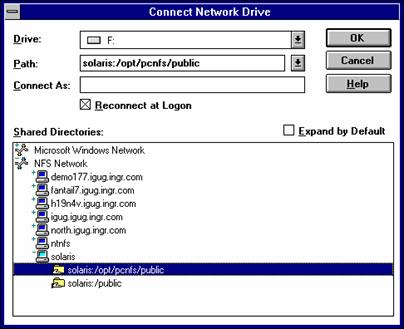
Windows NT also supports connectivity to other networks and servers with third party products for NFS, Banyan® VINES®, DEC® Pathworks™, and other networks. The picture at left shows a dialog box with a Windows NT system connecting to an NFS server. There is just a single, unified dialog box that allows users to access any network resource, including Windows NT, NFS, or NetWare servers—this makes it easy for users to move between different systems.
Integrated networking is central to making workstation users more productive. By including standard protocols and network services, coupled with an open architecture where it’s simple to add other services, you can get Windows NT up and running on your network with a minimum amount of effort.
In a workstation environment, you may want to distribute project work to team members across several workstations. Distributed applications, sometimes called workgroup applications, need a common framework for this to happen efficiently. But, that framework on traditional workstations is often proprietary. Over and above the basic TCP/IP network protocols, Windows NT is compatible with the Distributed Computing Environment (DCE) specification which is supported by many systems vendors.
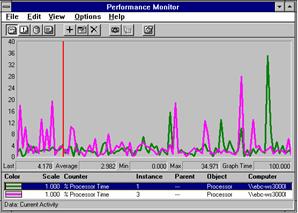
This compatibility ensures an even deeper level of interoperability with UNIX systems. Moreover, rather than creating unique remote procedure mechanisms, Microsoft supports standard Remote Procedure Call (RPC) functions which form the fundamental DCE building blocks for communicating between remote systems. Windows NT uses these RPC functions within the operating system itself and within many of the remote administration tools, such as the Performance Monitor and Event Viewer.
Beyond the base technology, users simply want to be able to use applications that might be distributed across the network. In a traditional workstation environment, the UNIX multi-user model is usually based around terminal-host computing. Today, this generally means that the user interface is distributed across a network using the X Window System. This means that, for example, you produce graphics on a remote system and simply display them on your desktop.
In contrast, Windows NT is optimized for distributed applications using the client-server model. In this model, more of the application runs on the client system rather than the remote system. One benefit of this model is that you can easily transfer data between different applications using OLE or other techniques. A second benefit is that users can continue to work on their desktop system even if the network fails or has performance problems. Of course, although client-server systems are the target for Windows NT, with various 3rd party options for X Window technology or telnet daemons, Windows NT can support multi-user environments in ways similar to UNIX.
Example: In both distributed models, you can run several applications at the same time. In the X environment, for example, you may have one session running Pro/ENGINEER on a Silicon Graphics Indy and a second session running Frame on a Sun Sparcstation. However, you still can’t share a rendering between the two sessions because it requires more than just connectivity. With Windows NT, it’s easy to transfer data using cut-and-paste of OLE objects since the applications run on one desktop.
With these distributed capabilities, Windows NT can be easily integrated into existing networks and easily communicate with existing UNIX workstations. Windows NT supports basic networking, integrated into the operating system, and can be easily extended into more complex networks as well. In short, Windows NT is the most well-connected operating systems available to you today.
You use workstations as a tool to increase your productivity. However, it is not the computer hardware that helps you get things done. The operating system provides you with the power and features that are needed by the applications used on workstations. Windows NT Workstation provides all of the advanced operating system capabilities that you expect of a high performance workstation operating system—and in some areas, it offers even greater flexibility and reliability than other advanced operating systems.
Windows NT includes kernel and memory management features that define traditional workstation operating systems. Also, as already described in this paper, it supports the advanced graphics capabilities and integrated networking characteristic of workstation systems. This section of the paper discusses how Windows NT Workstation meets and exceeds the basic requirements for a workstation operating system.
You would expect that workstation-class operating systems would be based on state-of-the-art technology. However, traditional workstation operating systems, such as UNIX, are still based on an architecture that is over twenty years old. Windows NT takes advantage of many enhancements in operating system technology that have been made over the last five to ten years.
From the kernel to the environment subsystems, Windows NT is designed to be an efficient, reliable, and extensible operating system without the legacy compromises that burden other systems. Windows NT is a fully 32-bit operating system that allows applications to use the raw performance offered by the current generation of high performance CPUs. This 32-bit architecture extends to all operating system modules.
|
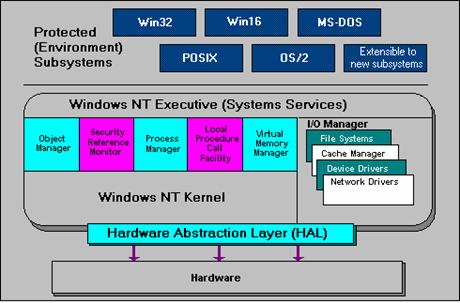
Figure 7 - The Windows NT operating system is based on a modular architecture. |
Windows NT is a modular operating system designed around modern principles. The basic architecture is shown in Figure 8. Each module provides a basic operating system service needed by applications or other parts of the operating system. The major components forming Windows NT are the kernel, the hardware abstraction layer (HAL), the executive, and the protected subsystems where user applications run. In moden operating systems, applications are kept separate from the operating system to ensure greater reliability.
Example: If you’re an architect or a engineering consultant, using AutoCAD to design new projects while also maintaining client correspondence, project management of existing contracts, and estimates for prospective new clients, wouldn’t you want to get everything done on a single computer? Windows NT offers greater efficiency by providing effective multi-tasking between all these functions. Its advanced kernel and 32-bit architecture give you higher levels of performance. Windows NT also enables these applications to easily share data.
This design results in a very stable operating system kernel with the flexibility to add additional components as they become available. Enhancements to the operating system can occur easily in the protected subsystems. Consequently, changes cannot affect the stability of the operating system. Contrast this architecture with the traditional UNIX systems in which the kernel absorbs most new functionality. Monolithic kernels like UNIX are more complicated to support and, in the long-term, become harder and harder to maintain.
The Windows NT kernel enables pre-emptive multi-tasking between applications. With pre-emptive multi-tasking, the operating system ensures that no single application can use all of the system resources and, consequently, prevent other applications from running. The kernel schedules time slices for each running application based on its priority. This scheduling ensures that all running applications have enough system resources and, overall, results in a high level of performance. The stronger the pre-emptive multi-tasking design is, the smoother the operating system feels to the user.
Windows NT is designed to run with a variety of CPUs and hardware platforms which offer advanced users a choice of systems from which they can select the right balance of performance and price. This choice of system hardware places demands on the operating system to efficiently reconcile hardware-specific needs, such as interrupt handling, cache management, memory handling, register assignments.
To solve this issue, Windows NT separates the kernel code from the hardware using an isolation layer referred to as the Hardware Abstraction Layer or HAL. The HAL presents a “virtual machine” to the kernel, executive, and device drivers. It maps this virtual machine onto the underlying hardware and eliminates the need for Windows NT to provide hardware specific kernels, thereby improving overall efficiency.
The Windows NT Executive is a family of software components that provide basic operating system services. These components are completely independent of the others and communicate through carefully controlled interfaces. This modular design allows existing components to be replaced with newer features or technology as they become available.
“On every system we’ve run it on, from a desktop PC to a high-end RISC machine, Windows NT Workstation is as stable as a Rolex watch. In at least our first three months of 24-hour-a-day usage, not a single system running Windows NT Workstation crashed.”
Paul Bryant, Foundation Imaging, Inc.
Some of the basic services provided as part of the executive include the process manager, I/O manager, object manager, security monitor, and many others. Within the executive, the process manager handles the user applications. When an application is invoked, it dynamically reserves a private address space to ensure that it will not interfere with other applications or the operating system itself.
Each process also has one or more threads where each thread represents an independent portion of that process. Threads inherit the priority of the parent¾Windows NT supports 32 priority levels for applications. The process priority is used by the kernel to schedule execution of each thread. This process model results in very efficient scheduling of all applications running on the system.
The I/O subsystem supports functions that range from traditional, synchronous buffered read-and-write operations to high speed buffer-mapped asynchronous I/O operations. Except for creation of the I/O channel itself, all internal I/O operations in Windows NT are asynchronous in nature¾that is, I/O operations do not have to wait for the I/O request to complete before doing something else. This improves overall system responsiveness.
Protected subsystems
Environment subsystems are used by Windows NT to provide the run-time environments for applications that might be native to different operating systems. Windows NT comes with three standard environment subsystems integrated into the operating system: Win32, POSIX, and OS/2®. Each of these environments provides the primitives that are specific to the applications developed for that user environment. As a result, Windows NT offers more flexibility than other workstation operating systems.
Workstation applications have a huge appetite for memory and storage capacity. In fact, you are probably limited in your day-to-day usage of applications more by memory than by CPU performance. Windows NT employs an advanced memory management model coupled with a new, sophisticated file system that allows users to run larger, more complex applications and manipulate large data models with higher levels of performance. Windows NT can address up to 4 GB of RAM with a completely flat address space¾each application and the operating system can use up to 2 GB of memory apiece. This can be extended with virtual memory so that applications can use more memory than is physically present on their computers.
With virtual memory, the operating system assigns a large address space to an application by mapping virtual addresses onto physical memory. As physical memory fills up, selected memory addresses are swapped to the hard disk and can be recalled on demand. With this model, Windows NT effectively eliminates the ‘out of memory’ errors often seen in other operating systems. The flat address space, coupled with this virtual memory, lets Windows NT manage enough memory for almost any application.
Not only do workstation applications need memory to run, they often generate so much data that you can fill up gigabytes of disk space. The native Windows NT File System (NTFS) is the solution—NTFS supports up to 16 exabytes (17 million gigabytes) of disk storage with its 64-bit file system. Windows NT also supports FAT, CDFS, and HPFS file systems for compatibility with other operating systems. Windows NT further supports installable file systems so that products from vendors such as Intergraph, DEC, and Banyan, as well as advanced products such as optical jukeboxes, can be used.
NTFS is an advanced journaling file system that provides recoverability, security, and fault-tolerance. It includes security attributes enabling users to share a common disk but not have access to other users’ files on that same disk, unless given explicit permission. NTFS also supports configurable block-sizes and pre-allocated files which can improve overall disk throughput. Altogether, these advanced memory management and file systems capabilities help support the powerful, memory-starved applications you are using on workstations today.
For users who already are very familiar with UNIX, a wide variety of tools and utilities are available for Windows NT. These tools help ensure that these users will be instantly productive in the Windows NT environment.
In addition to the ftp and telnet capabilities already built into Windows NT, a number of other Internet tools are available as native applications and services. For desktop access to the Internet, such tools include: archie and gopher search tools, NCSA Mosaic, Netscape Navigator, and the new 3D Webscape from Template Graphics Systems.
Internet server technology is also within reach with Web servers readily available from Process Software (Purveyor) and O’Reilly and Associates (WebSite), in addition to various others that are based on WAIS, gopher, and http technologies.
Many of these Internet tools are included within the Windows NT Resource Kit. Moreover, source code for many of these Internet tools and other common utilities is freely available on the Internet. For example, one source for many of these tools can be found by browsing the GNU archives at the University of Texas at ftp://microlib.cc.utexas.edu in /microlib/nt/new.
|
Shells & utilities |
Vendor |
Product Name |
|
|
Congruent Technology |
GNU Toolbuster CD |
|
|
Hamilton Labs |
C Shell for Windows NT (includes ls, rm, cp, grep, fgrep, mv, sed, tar and other commands) |
|
|
MKS |
MKS Toolkit (includes Korn Shell plus vi, awk, and over 170 other commands) |
|
X Servers |
Vendor |
|
|
|
AGE Logic, Inc. |
Xoftware/32 for Windows NT |
|
|
DEC |
eXcursion for Windows NT |
|
|
Intergraph Corp. |
eXalt for Windows NT |
|
|
Hummingbird Ltd. |
eXceed |
|
|
NCD PC Xdivision |
PC-Xware for Windows NT |
|
NFS Products |
Vendor |
|
|
|
Beame & Whiteside |
BW-Connect NFS for Windows NT |
|
|
Intergraph |
PC-NFS for Windows NT (client) |
|
|
Intergraph |
DiskShare (server) |
|
|
NetManage |
Chameleon32/NFS |
Table 5 - Many common UNIX utilities and products are available for Windows NT
Development tools for Windows NT are abundant. Microsoft offers the Visual C++™ development system and FORTRAN compilers for Windows NT. A number of 3rd party compilers and other tools are also available, including Ada, COBOL, Forth, LISP, Modula-2, Pascal, Prolog, Smalltalk, Perl, and more.
Cross-platform development tools, source code management systems, and other development tools are also available to aid in developing applications for, or porting applications to, Windows NT. If you are developing applications for use around the world, then Windows NT makes it a little easier with support for Unicode—an encoding standard capable of representing all character sets.
Conversion tools such as NuTcracker (from Data Focus) and Portage (from Consensys) make Windows NT look like a normal UNIX development environment. These tools are often used to convert UNIX application source code into Win32-compliant code so that existing applications can be recompiled and executed. Developers can then easily optimize the resulting code for use with Windows NT.
Microsoft also offers a comprehensive service for developers called the Microsoft Developer Network (MSDN). This service helps support developers working on applications for use with Microsoft operating systems. MSDN includes a wide variety of tools including:
| Software development and device driver development kits including sample code. |
| Complete documentation for all operating systems and development tools in an on-line/searchable database. |
| Selected international versions of operating systems. |
| The Microsoft knowledge base. |
For more information on developing for Windows NT, check out our web server www.microsoft.com or call 800-759-5474. Microsoft also has a fax-back service available at 206-635-2222.
The latest release of Windows NT Workstation, version 3.51, includes many new features. The following table outlines the feature set of this new version.
|
Category |
Feature |
||||||||||||||||||||
|
Application support |
|
||||||||||||||||||||
| Networking |
|
||||||||||||||||||||
| Remote Access Services (RAS) |
|
||||||||||||||||||||
| Messaging |
|
||||||||||||||||||||
| Security |
|
||||||||||||||||||||
| Graphics and multimedia |
|
||||||||||||||||||||
| Utilities |
|
||||||||||||||||||||
|
Remote management |
|
||||||||||||||||||||
| Hardware support |
|
Advanced computer users use powerful workstation systems to get work done more efficiently. However, if you need two computers, one personal computer and one workstation, on your desk to run all of your applications, then you lose this efficiency. Even if you only have one system on your desk, it is still often difficult to share data and designs with users in another department—and much, much more difficult if you want to share data directly with your customers or other organizations.
|
|
So, how can you improve your productivity and responsiveness even more?
Windows NT Workstation offers you a workstation-class operating system designed to give you the power of a workstation coupled with the ease-of-use, productivity, and compatibility of a Windows-based personal computer. Windows NT Workstation offers you capabilities that are equivalent to or, often, more advanced than traditional workstation operating systems provide.
Windows NT Workstation runs on a broad, non-proprietary spectrum of hardware ranging from Intel-based personal computers to multi-processor RISC-based systems. Compared to traditional workstation hardware that is based on proprietary CPUs and operating systems, the Windows NT solution is less costly. Beyond cost, there are other compelling reasons to consider Windows NT Workstation.
|
Windows NT Workstation helps you become more productive by enabling better integration between your applications and data. It also lets you save money by consolidating your applications onto a single system. |
|
Windows NT Workstation makes no compromises when it comes to performance. Ensuring portability and scalability across different systems ensures that you can pick the right hardware to give you the performance you need. |
|
Windows NT Workstation lets you easily connect to your legacy servers or other resources with complete networking capabilities that are built into the operating system. |
|
Windows NT Workstation meets and exceeds the native capabilities of traditional workstation operating systems. You can rest assured that it has the power and robustness that you need for all of your workstation needs. |
With this combination of powerful capabilities, Windows NT Workstation has already changed the workstation business.
|
The Microsoft Strategy for Distributed Computing and DCE Services, White Paper, Microsoft Staff, February, 1995. |
|
Microsoft Windows NT 3.5: The Internet Platform for Today’s Business Needs, Backgrounder, Microsoft Staff, April, 1995. |
|
OpenGL 3-D Graphics, Technology Brief, Microsoft Staff, April, 1995. |
|
Real-Time Systems With Microsoft Windows NT, Technology Brief, Microsoft Staff, April, 1995. |
|
Windows-family Integration with UNIX Systems, White Paper, Microsoft Staff, February, 1995. |
|
Windows NT from a UNIX Point of View, White Paper, Microsoft Staff, August, 1995. |
|
Inside Windows NT, Helen Custer, Microsoft Press, 1993. ISBN 1‑55615‑481‑X |
|
Inside the Windows NT File System, Helen Custer,
Microsoft Press, 1994. |
|
Microsoft Windows NT: A Strategic Review, Cliff
Leach, Prentice Hall, 1993. |
|
Opportunities for Windows NT in the Workstation Market, IDC, May 1994 |
|
Windows NT for the Technical Professional, Louis Columbus and Nik Simpson, Onword Press, 1995. ISBN 1‑56690‑064‑6 |
|
Windows NT Resource Kit, Microsoft Press, 1995. ISBN 1‑55615‑657‑X Includes four volumes: Windows NT Resource Guide, Windows NT Networking Guide, Optimizing Windows NT, and Windows NT Messages. |
|
Windows NT Training Kit, Microsoft Press, 1995. ISBN 1‑55615‑864‑5 |
Microsoft information sites on the Internet
|
Microsoft FTP Server: |
ftp.microsoft.com |
|
Microsoft WWW Server: |
www.microsoft.com |
Internet Web sites for some companies referenced in this paper
|
Autodesk |
www.autodesk.com |
|
Bentley Systems |
www.bentley.com |
|
Digital Equipment |
www.digital.com |
|
EMWAC |
www.ed.ac.uk |
|
Hummingbird |
www.hcl.com |
|
Intergraph |
www.intergraph.com |
|
Mathsoft |
www.mathsoft.com |
|
Molecular Dynamics |
www.mdyn.com |
|
NCSA |
www.ncsa.uiuc.edu |
|
NetManage |
www.netmanage.com |
|
NeTpower |
www.netpower.com |
|
NewTek |
www.newtek.com |
|
Template Graphics |
www.cts.com/~template |
|
Visual Numerics |
www.vni.com |
|
Vox-L, Inc. |
www.dataspace.com/www/vox-l.html |
|
Wolfram |
www.wri.com |
Notes
Note 1: Based on IDC analysis of typical prices of personal computer and workstation hardware.
Note 2: As reported in the 12/26/94 issue of InfoWorld.
Note 3: Two books on OLE may be of interest. Inside OLE 2 by Kraig Brockschmidt and Microsoft OLE 2 Programmer’s References (2 volumes) by Microsoft staff. Both are published by Microsoft Press.
Note 4: OLE for Design & Modeling is an open specification developed as part of the Microsoft open design process which seeks input from vendors within an industry. This specification was proposed and is maintained by vendors including Intergraph, Autodesk, Bentley Systems, Microsoft, and many others.
Note 5: For an up-to-date Windows NT applications catalog, call 800-426-9400 and request the InfoSource CD (P/N 098-60374). This CD has other information on Windows NT and Microsoft BackOffice products.
Note 6: Over 2,000 applications are now available for Windows NT. This list is not comprehensive but is representative of vendors in particular applications areas.
Note 7: The current Windows NT Hardware Compatibility List is available from Microsoft’s FTP server (ftp. microsoft.com) as well as Compuserve in Library 1 of the WINNT forum.
Note 8: Systems in this table have high-end configurations. A more typical system for Windows NT Workstation might cost $3,000 for a Pentium CPU, 16MB memory, 1 GB disk, network card, and a 17” monitor.
Note 9: Pro/ENGINEER User Magazine published these benchmarks in the 1994 November/December issue. The NeTpower system did not have accelerated 3D graphics adapters yet performed very well against the HP 735 and the SGI Indigo2 systems with 3D accelerator cards. All systems had 64MB of memory.
Note 10: To learn more on developing multi-threaded applications, refer to the “Developing Multi-Threaded Applications” presentations made by Mark Lucovsky and John Vert at the 1995 Client-Server Development Conference. These presentations are part of the Software Development Kit (SDK) for Windows NT.
Note 11: This driver model is the same model being used to accelerate Reality Lab which Microsoft obtained with its recent purchase of RenderMorphics. This driver model is also supported on Windows 95 so that, when OpenGL is delivered for Windows 95, it will also be able to take advantage of 3D hardware.
Note 12: A more complete discussion of the support that Windows NT offers for real-time applications can be found in the Real-Time Systems Technology Brief prepared by Microsoft.
Note 13: Windows NT includes TCP/IP, IPX/SPX, and NetBEUI. Plus, an OSI TP4 transport is available from AT&T and a DECnet transport is available from Digital Equipment Corporation.
Note 14: The Banyan Vines redirector for Windows NT is available free of charge directly from Banyan.
Note 15: Although new UNIX versions with new capabilities are released constantly by different vendors, most are still derived from AT&T System V or Berkeley UNIX 4.XBSD—both introduced in 1983 or earlier.
Note 16: In addition to the 32-bit APIs central to native Windows NT applications, 16-bit MS-DOS® and Windows-based applications are supported through protected environment subsystems.
Note 17: The microkernel design was a part of the Mach operating system developed at Carnegie Mellon. The Mach microkernel is very efficient when performing critical tasks.
Note 18: MS-DOS and Win16 for 16-bit Windows-based applications are supported by the Win32 environment subsystem. With these applications, a Virtual DOS Machine is started. Windows applications also use an additional capability called Windows on Win32 (WOW) to pass their data directly to Win32 APIs.
Note 19: FAT is the File Allocation Table format used with MS-DOS and Windows, CDFS is the CD file system used with compact discs, and HPFS is the High Performance File System used with OS/2.
Note 20: Designed to comply with the US government’s C2 and European Community’s E3 security standards.
Note 21: A list of over 100 tools and utilities is available on the Microsoft Internet web server at http://www.microsoft.com/pages/bussys/internet/tools.htm. This web page is updated constantly.
Note 22: These products are as close to UNIX on Windows NT as you can get. For example, Portage is derived from the original System V, Release 4.2 source code. Both products include options for common features such as X/Motif libraries.
Note 23: “Opportunities for Windows NT in the Workstation Market”, IDC, May 1994.
Note 24: UNIX-based workstations are priced anywhere between roughly $10k through $100k or higher if exotic peripherals are needed; IDC research shows that the tyipcal entry-level workstation for engineers costs between $12-15k. In comparison, workstations based on Windows NT start with prices as low as $3k.
Legal Notice
The descriptions of other companies’ products in this paper are provided only as a convenience to the reader. Microsoft cannot guarantee their accuracy, and the products may change over time. Also, the descriptions are intended as brief highlights to aid understanding, rather than as thorough coverage. For authoritative descriptions of these products, please consult their respective manufacturers.
The information contained in this document represents the current view of Microsoft Corporation on the issues discussed as of the date of publication. Because Microsoft must respond to changing market conditions, this document should not be interpreted as a commitment on the part of Microsoft, and Microsoft cannot guarantee the accuracy of any information presented after the date of publication.
This document is for informational purposes only. MICROSOFT MAKES NO WARRANTIES, EXPRESS OR IMPLIED, IN THIS DOCUMENT.
©1995 Microsoft Corporation. All rights reserved. Microsoft, MS-DOS, Win32, Win32s, Windows and the Windows logo are registered trademarks, and Visual C++ and Windows NT are trademarks of Microsoft Corporation. OSF and DCE are registered trademarks of the Open Software Foundation. DEC, PATHWORKS, and Alpha AXP are trademarks of Digital Equipment Corporation. IBM and OS/2 are registered trademarks and PowerPC is a trademark of the International Business Machine Company. UNIX is a registered trademark of Novell, Inc. in the United States and other countries, licensed exclusively through X/Open Company, Ltd. HP-UX is a trademark of Hewlett-Packard Company. SunOS is a trademark of Sun Microsystems. Pentium is a trademark of Intel Corporation. OpenGL is a trademark of Silicon Graphics, Inc. IRIS GL is a trademark of Silicon Graphics, Inc. Novell is a registered trademark of Novell, Inc. Banyan VINES is a registered trademark of Banyan Systems, Inc.
Return to other papers and articles.
| Face-Off: UNIX versus Windows NT, August 1994 |
| Real-Time Systems With Microsoft Windows NT Technology Brief, April 1995 |
| OpenGL 3-D Graphics Technology Brief, August 1995 |
|

| ||||||||||||||||||||||||||||||||||||||||||||